AI & the Creative Industry · Opinion
Why Cheap Renderings Cost More Than Expensive Ones
By Hugo Ramirez · June 8, 2026
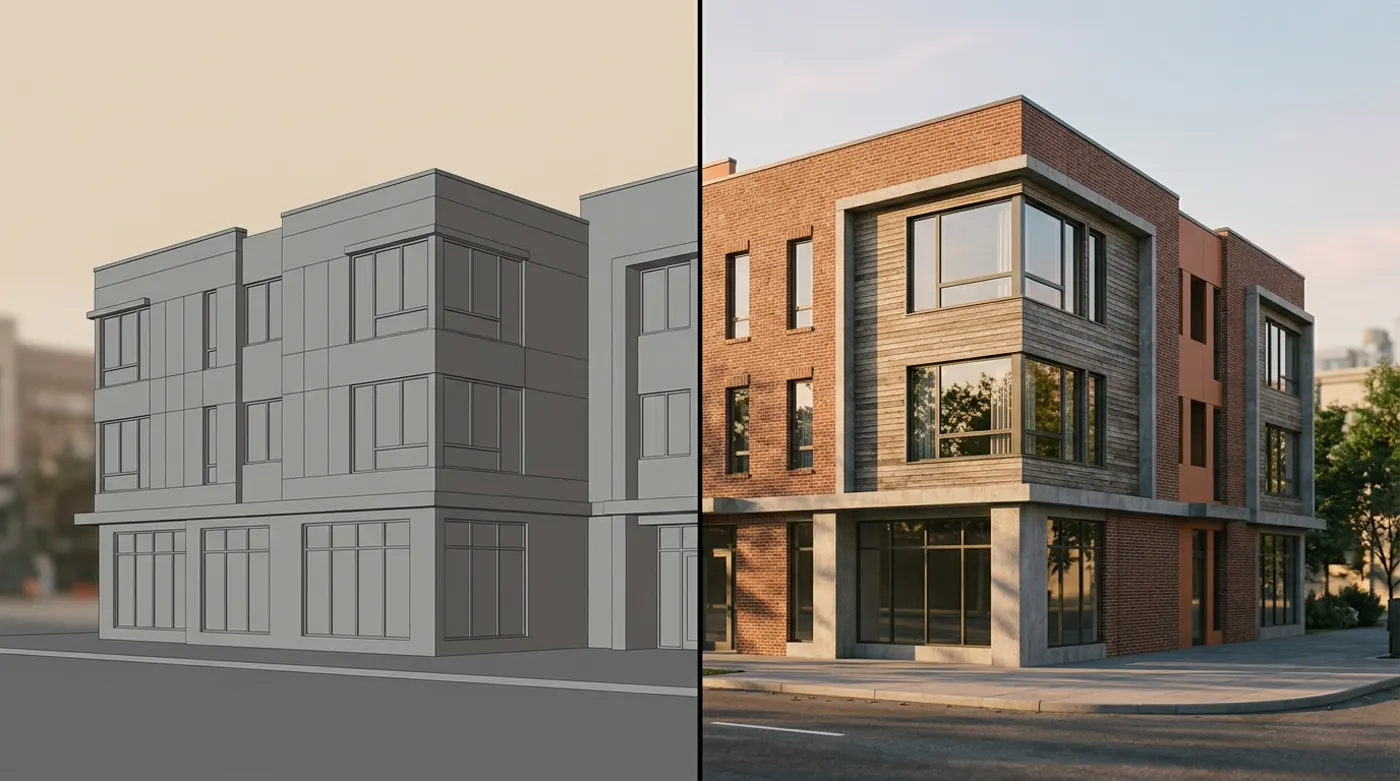
The price of a rendering is the smallest number in the transaction. Everything it influences is bigger.
Key takeaways
- The price of a rendering is tiny next to what it influences: a sale, a permit, an investor's first impression.
- Cheap renderings cost more in three hidden places: rework, wrong decisions baked into a build, and lost trust.
- AI made competent-looking wrong renderings free. It did not make judgment free, which is what you actually pay for.
- The honest test: if this image fails, what fails with it? If the answer is real money, buy the good one.
A developer once told me he had found renderings for a quarter of what we quoted. I told him to take the deal. I meant it.
Then I asked him one question: what is this rendering for? He paused. It was for a pitch to investors on an eleven-million-dollar mixed-use project. He was about to put a four-hundred-dollar image in front of the most important decision of his year.
That is the part people get wrong about cheap work. They price the rendering. They never price what the rendering is standing in for.
The image is not the product
When you buy a rendering, you are not buying pixels. You are buying the few seconds where someone who controls money looks at a screen and decides whether to lean in or lean back. That decision happens before they read a single number on your pro forma. It happens in the part of the brain that does not do spreadsheets.
A flat, gray, slightly-off rendering does not read as “we saved money.” It reads as “these people are not ready.” Nobody says that out loud. They just get a little more skeptical, ask a little harder, and discount the rest of your pitch by a margin you will never see itemized. The cheap rendering did its damage silently and you blamed the market.
I have watched the opposite too. A good image buys you the benefit of the doubt for the next twenty minutes. That is worth a lot more than the few hundred dollars you spent.
Where the real cost hides
Cheap renderings cost more in three places, and none of them show up on the invoice.
Rework
The first version is wrong because the brief was rushed, so you go back and forth, and the cheap vendor either nickel-and-dimes each revision or disappears. You end up paying twice and you lost three weeks. In development, three weeks can be a financing window.
Wrong decisions
This is the dangerous one. A rendering with bad lighting and made-up materials does not just look worse, it lies. The client approves a finish that does not exist at that price, or rejects a design that would have worked because the image undersold it. Now the error is baked into a build, and the cost of fixing a mistake climbs steeply the later it is caught in any project, construction included.
Trust
The most expensive line item and the one founders ignore. Your rendering is often the first work product a client ever sees from you. First impressions form in a fraction of a second and are slow to revise. If it looks careless, they assume the build will be careless. You spend the rest of the relationship paying that back.
”But AI makes renderings free now”
I run a visualization company, so people expect me to be defensive about this. I am not. AI has made the bottom of this market collapse, and good. The four-hundred-dollar pitch image that used to be someone’s careless freelance job is now genuinely free, and it looks about as convincing as it always did.
What AI did not do is make judgment free. The hard part of a rendering was never rendering. It was knowing that this material reads wrong under this light, that this camera height flatters and that one lies, that the client said “modern” but means “warm,” that the planning board will fixate on the parking edge so do not fake it. That is taste and experience, and the tools made it more valuable, not less, because now everyone can produce a competent-looking wrong answer in seconds.
At Rendimension the work that grew was never the cheap tier. It was the projects where the image had to carry real money and the client knew it. The tools changed. The thing people actually pay for did not.
The honest test
Here is how I tell a founder whether to buy cheap or buy well. One question: if this image fails, what fails with it?
If the answer is “nothing, it is for a Tuesday social post,” buy cheap, or make it yourself for free. I mean that with no condescension. Not every image is load-bearing.
But if the answer is “a sale, a permit, an investor, a client’s first impression of us,” then the rendering is the cheapest insurance you will ever buy on the most expensive thing in the room. Spending more there is not extravagance. It is just pricing the risk correctly, which is the whole job of running anything.
The developer with the eleven-million-dollar project did the math in about four seconds. He paid for the good ones. He got the money.
The rendering was never the expense. It was the smallest number on the table, pretending to be the decision.
Frequently asked questions
Why do cheap renderings end up costing more?
Cheap renderings carry hidden costs in three areas: rework (wasted time and back-and-forth), wrong decisions (inaccurate images lead to build errors measured in thousands, not hundreds), and lost trust (a careless first impression makes clients assume the whole project will be careless).
Does AI make professional rendering services obsolete?
No. AI can produce a basic image for free, but it does not replace judgment, experience and taste: knowing how a material reads under a given light, which camera height flatters, what the client means by 'modern,' and what a planning board will fixate on. AI makes a competent-looking wrong answer free, which makes good judgment more valuable, not less.
How do I know if I need an expensive rendering or a cheap one?
Ask one question: if this image fails, what fails with it? If the answer is 'nothing, it is for a social post,' buy cheap or make it yourself. If the answer is 'a sale, a permit, an investor, a client's first impression,' the rendering is the cheapest insurance you will buy on the most expensive thing in the room.